


|
|
|
|
 Accueil - Home Accueil - Home |
 More SEX
& Culture - Cul & Cul-ture More SEX
& Culture - Cul & Cul-ture |
| (*) The French pun 'Cul'
<>. 'Cul-ture' has no English equivalent. 'Cul'
means 'butt', 'ass', but , very familiarly, it can
also mean 'sex' in such phrases as 'Photos de
cul' > sex photos or 'histoires de cul' > sex
stories. Hence my translation as Sex and Culture. |
Historia de duobus amantibusHistoire de deux amants
 Gravures sur bois d'une édition
italienne de 1470 de l'Histoire de deux amants
Et Euryale d'ajouter "Qu’il y a-t-il de plus beau, de
plus resplendissant que ce corps ? […] Ô noble poitrine,
ô seins qui s’offrent à la caresse, est-ce vous que je
touche, vous que je tiens, vous sur lesquels courent mes
mains ? Ô douces formes, ô corps parfumé, est-ce bien
toi que je tiens, es-tu vraiment mien ? […]
Douceur de nos baisers, douceur de nos corps enlacés,
personne ne fut jamais plus heureux que moi". |
Historia de duobus amantibusThe Tale of Two LoversThis chapter is different from the others. This why I have kept the Latin title of the novel I am writing about. Instead of highlighting a relationship between art and gay sex, I deal here with a male - female relationship, that of a mistress and her lover. It must be pointed out that the text I am referring to was written in 1440 and was designed for a refined readership of great aristocrats and intellectuals who were living in a world extremely different from ours. Literature-wise, the educated readers of past times understood allusions to ancient mythology and appreciated the "language of equivocation " which uses verbal disguise and aims at softening the crudeness of expression without concealing the real meaning. Hence, there is no crudeness, let alone obscenity, but a transparent veil thrown over the narrative so as not to overstep the formal limits of conventions and contravene decency. The fact remains what the author meant to express is expressed indeed! So why this article, which ultimately has nothing to do with gay sexuality, and which does not even seem really smutty ? The answer lies in the name, social status and functions of the author, which I will reveal at the end. The name of an author of an erotic story that no one, either in the past or today, would have considered mentioning... Enea Silvio Piccolomini, his real name, born in 1405, was a well-known humanist, a man of letters, a famous writer, the author of poetic and romantic works who left behind an important (and entirely ‘serious’) body of work. However, among his works there is a surprising novel, written in his youth, an erotic book entitled Historia de duobus amantibus (The Tale of Two Lovers). (Yes, this great intellectual wrote in Latin!) The plot tells the meeting of Lucretia, a young married bourgeois woman from Siena, and Euryalus, a member of a princely delegation passing through the city. They fall in love, get impassioned; the writer makes a very clear and vivid description of the consummation of this carnal story of forbidden love. For the 15th century, the writing is quite daring. Judge for yourself: Lucretius wore a light dress that clung to her body and concealing neither her breasts nor her hips. She displayed her limbs exactly as they were: her throat was snowy white, her eyes shone with the radiance of the sun, her glance was happy [...] She was deep-bosomed, and her breasts swelled out like two pomegranates, so that one longed to touch them.  Wood engravings from an Italian
1470 edition of the Tale of Two Lovers
The lovers have to find various means to keep unwanted persons away, the husband in the first place but finally... Lucretia said : "‘Come , Euryalus, my heart. Come, fountain of my pleasures, my spring of happiness. Come, my incomparable darling. For all is safe now for our conversation and our embraces. Euryalus could contain himself no longer, but forgot his fear and cast aside all modesty. Coming close to her, he said:" At last let us enjoy pour love," and he matched his actions to his words. He seized her dress, half tore it; and while she resisted with no desire to win, he easily got the better of her. […] Speaking together thus, they went into her room, where they passed such a night as, I imagine, the two lovers spent, when Paris had carried off Helen in his tall ship; so sweet a night that both Mars and Venus could not have been better together. He marvelled at his eyes on her mouth, her cheeks and her eyes. Lucretia answered: "You are my Ganymede, my Hippolytus, my Diomedes. [...] And sometimes, raising the blanket, he gazed at those secret parts he had not seen before, and cried :" I find more than I had expected ". And Euryalus added, "What could be more beautiful, more resplendent than this body? [...] O noble breast, O breasts that offer themselves to caresses, am I touching you, am I holding you, you that my hands are fondling ? O sweet forms, O perfumed body, is it truly you that I am holding, are you really mine? [...] Sweetness of our kisses, sweetness of our entwined bodies, no one has ever been happier than I. " Not a kiss that was not returned, not a word of love that was not repeated. He kissed her and she kissed him. They embraced, held one another other tight, and never felt the fatigue of love, but like Antaeus, who rose ever stronger, they found strength and energy in their amorous struggles. But when morning came, desperate, they had to part: " O white bosom, O sweet tongue, O languid eyes, O beautiful spirit, O marble body filled with sap? When will I kiss those ruby-red lips again? When will I feel your nimble tongue in my mouth again? Will I take your breasts in my hands again?" Just imagine the erotic, even pornographic, scene a modern film maker could shoot. Isn't sex clearly described despite a certain restraint in the expression ? It is clear that this text was written for educated readers, capable of understanding (unlike us), for example, the salacious allusions to Paris and Helen (the latter is abducted by her lover, the Trojan prince Paris), the references to Ganymede (Zeus is in love with this beautiful boy), Hippolytus, Diomedes and Antaeus - all references to mythology that also evoked erotic, even pornographic images in ancient readers. On the other hand, the meaning of certain other metaphors is barely concealed, such as the image of sap filling Lucretius' body. 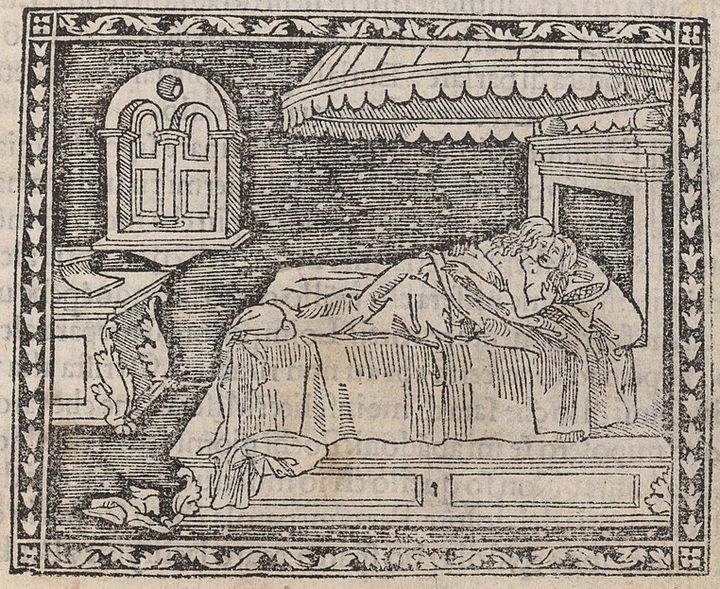 This novel was hugely successful, first published in manuscript form, then translated into several languages and printed several times (more than 40 editions). Our author, Enea Silvio Piccolomini, a native of Siena, led two lives: he was first a well-known and renowned man of letters with an abundant literary and historical oeuvre. A work of high intellectual calibre, of a completely different quality from that of our rather risqué story, a mere work of youth. But when he reached the age of about 40, he changed course completely, becoming a priest and then a bishop (in Trieste), then, after climbing all the steps of the ladder, he was elected pope in 1458 and took the name Pius II. (During his pontificate, historians say, he strove to restore the moral authority of the Holy See and was morally a humble and faithful pope, mindful of his duties.) Thus, among works of great value, we find a novel that is quite daring and surprising for a future pope... It is difficult to imagine the terms “eroticism” and “pope” together, and yet it is possible.. |
| Accueil - Home |
| More SEX
& Culture - Cul & Cul-ture |