


|
|
|
|
 Accueil - Home Accueil - Home |
 More SEX
& Culture - Cul & Cul-ture More SEX
& Culture - Cul & Cul-ture |
| (*) The French pun 'Cul'
<>. 'Cul-ture' has no English equivalent. 'Cul'
means 'butt', 'ass', but , familiarly, it also means
'sex' in such phrases as 'Photos de cul' <
sex photos> or 'histoires de cul' <sex
stories>. Hence my translation as Sex and Culture. |
|
Le premier couple gay de
l'histoire ?
La tombe de Khnoumhotep et
Niankhkhnoum, datant de la 5ème dynastie du roi
Niouserré, a été mise au jour en 1964 dans la
nécropole de Saqquarah,. Les deux défunts portaient le
titre de" Manucures du roi" Si ce titre nous semble
bien mineur il témoigne en fait d'une position de
grande confiance et d'intimité auprès du pharaon. Ces
hommes faisaient partie du cercle des courtisans de haut
rang, des rares personnes qui pouvaient approcher la
pharaon et même le toucher. Ils occupaient plusieurs
fonctions et portaient aussi d'autre titres, « gardien des
secrets », « familier du roi », « gardien des biens du roi
», « bien-aimé de son maître », « prêtre de Râ » et «
purificateur des places fortes de Niouserré » Avec un tel
rang social, il n'est alors pas étonnant de constater que
leur tombeau est l'un des plus grands et des mieux décorés
de la nécropole.
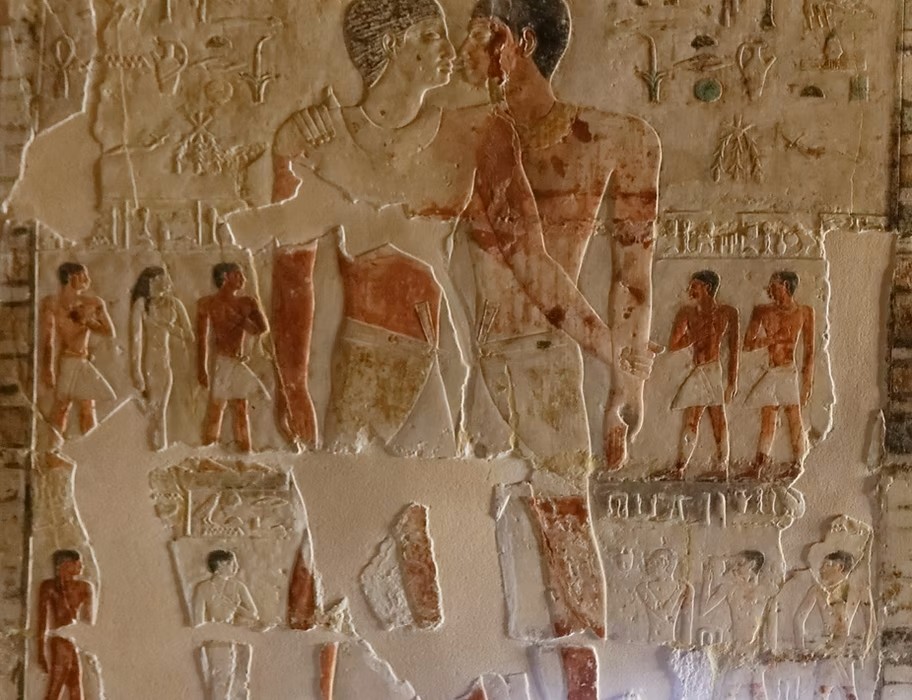
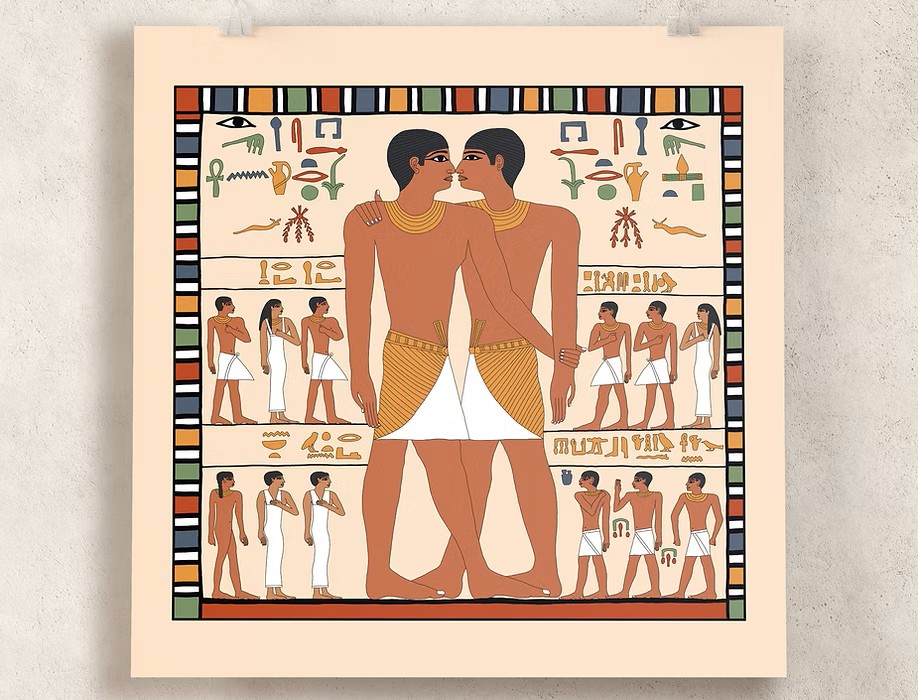
Niankhkhnoum et Khnoumhotep portaient les mêmes titres. Sur les reliefs, ils sont représentés égaux : l’égalité est rare dans les sépultures égyptiennes ; habituellement, le statut était souligné par la taille des personnages (ou par l’emplacement). Ici, chacun reçoit les mêmes offrandes, personne ne domine. De nombreux égyptologues pensent que Khnumhotep and Niankhkhnum étaient des frères, peut-être même des jumeaux. Cette théorie pourrait expliquer pourquoi ils partagent la même tombe. mais une chose est certaine : ces deux hommes étaient mariés et avaient des enfants (des peintures murales dans la tombe le montrent clairement), et malgré ce fait, ces deux hommes de même rang social sont enterrés ensemble dans la même tombe, ce qui est absolument unique. Tout porte à croire que leur famille (femmes et enfants) passait en second plan. Leurs épouses sont représentées de façon lointaine, et n'ont pas été enterrées à leurs côtés... De plus, les représentations artistiques à l'intérieur du tombeau fascinent les spécialistes en raison de la profonde affection et du sentiment d'intimité qui s'en dégagent. Dans plusieurs scènes, les deux hommes s'étreignent, se tiennent la main, autant de gestes qui, dans l'art égyptien, incarnent autre chose que la simple amitié et prouvent une relation très intime. Ces images ont donc suscité un long débat. S'agit-il de frères, de jumeaux, ou du premier couple de même sexe répertorié dans l'histoire ? Sur le mur est de la salle des offrandes, les deux hommes sont représentés dans l'étreinte la plus intime possible selon les canons de l'art égyptien antique. Niankhkhnoum, à droite, tient l'avant-bras droit de son compagnon ; Khnoumhotep, à gauche, a le bras gauche passé sur le dos de l'autre homme, serrant fermement son épaule. Ici, comme dans une autre partie de la tombe, ils sont si proches l'un de l'autre que leur nez se touche, leur torse se frôle , les nœuds de leur ceinture semblent se toucher, voire être noués ensemble. Ici, dans la partie la plus intime de leur tombe commune, les deux hommes se tiennent dans une étreinte destinée à durer pour l’éternité. Certains chercheurs affirment que Khnoumhotep et Niankhkhnoum formaient un couple de même sexe. Ils soulignent l’étreinte « nez contre nez », qui était le geste le plus intime autorisé dans l’art égyptien. (C’est ainsi qu’on représentait un baiser dans l’art égyptien ancien) Habituellement, seuls un homme et sa femme ou un parent et son enfant adoptent cette pose. La composition de ces scènes s'inscrit dans la tradition de la représentation des couples mariés. Le fait que les artistes aient utilisé cette iconographie qui dépasse ce qui était considéré comme la norme à l'époque de l'Ancien Empire, suggère un lien émotionnel profond ou même une relation amoureuse. Frères ou amants ? Le mystère restera peut-être à jamais enfoui dans les messages contradictoires des hiéroglyphes de la tombe, mais les mots que ces hommes ont choisi de faire graver au-dessus de l'entrée de leur tombe sont d'une clarté sans équivoque : « UNIS DANS LA VIE ET UNIS DANS LA MORT » |
The first gay couple in
history ?
The tomb of Khnumhotep and Niankhkhnum,
dating from the 5th Dynasty of King Neuserre, was dug in
1964 in the Saqqara necropolis. The two deceased bore the
title of ‘Manicurists to the King’. Although this
title may seem rather minor to us, it actually
attests to a position of great trust and intimacy with the
pharaoh. These men were part of the circle of
high-ranking courtiers, among the few people who could
approach the pharaoh and even touch him. They held various
roles and bore other titles as well, such as ‘Keeper of
Secrets’, ‘Confidant of the King’, ‘Keeper of the King’s
Property’, ‘Beloved of his Master’, ‘Priest of Ra’, and
‘Purifier of the Strongholds of Neuserre ”. It is
therefore not surprising that their tomb is one of the
largest and most elaborately decorated in the necropolis.
Niankhkhnum and Khnumhotep bore the same titles. In the reliefs, they are depicted as equals. Equality is rare in Egyptian tombs; usually, status was emphasised by the size of the figures (or by their placement). Here each receives the same offerings; neither dominates the other. Many Egyptologists believe that Khnumhotep and Niankhkhnum were brothers, perhaps even twins. This theory could explain why they share the same tomb. But one thing is certain: despite the fact that they were married and had children (wall paintings in the tomb clearly show this), the fact that these two men of equal social standing were buried together in the same tomb is absolutely unique. There is every indication that their families (wives and children) were treated as secondary. Their wives are depicted in a distant manner and were not buried alongside them... the artistic depictions inside the tomb fascinate experts because of the deep affection and sense of intimacy they convey. In several scenes, the two men embrace and hold hands – gestures which, in Egyptian art, signify more than mere friendship but a very intimate relationship.. These images have therefore sparked a long-running debate. Are they brothers or the first same-sex couple recorded in history? On the east wall of the offering chamber, the two men are depicted in the most intimate embrace possible according to the conventions of ancient Egyptian art. Niankhkhnoum, on the right, holds his companion’s right forearm; Khnoumhotep, on the left, has his left arm draped over the other man’s back, clasping his shoulder firmly. Here, as in another part of the tomb, they are so close to one another that their noses touch, their chests brush against one another, and the knots of their belts seem to touch, or even to be tied together. Here, in the most intimate part of their shared tomb, the two men stand in an embrace meant to last for eternity. Many researchers believe that Khnumhotep and Niankhkhnum were brothers, or even twins. This theory explains why they shared the same tomb. In Egyptian culture, brothers often appeared together in art. However, they were rarely depicted in such intimate poses. In recent years, a new theory has gained popularity. Some researchers claim that Khnumhotep and Niankhkhnum were a same-sex couple. They point to the ‘nose-to-nose’ embrace, which was the most intimate gesture permitted in Egyptian art. (This is how a kiss was depicted in ancient Egyptian art) Usually, only a husband and wife or a parent and child strike this pose. The composition of these scenes follows the tradition of depicting married couples. The fact that the artists employed this iconography, which went beyond what was considered the norm during the Old Kingdom, suggests a deep emotional bond or even a romantic relationship. Brothers or lovers ? The mystery may remain forever buried in the contradictory messages of the tomb’s hieroglyphics, but the words these men chose to have inscribed above the entrance are unambiguously clear: ‘UNITED IN LIFE AND UNITED IN DEATH’ |

|
Khnoumhotep and Niankhkhnoum n'ont pas
l'exclusivité de l'homosexualité dans l'Égypte
antique. Le mythe d'Horus et Seth évoque non seulement
l'homosexualité, mais aussi l'inceste. Dans les Textes des
Pyramides, découverts en 2001 dans la pyramide de Pépi
Ier., on voit Seth et son neveu Horus avoir des rapports
sexuels que le texte égyptien.ne cherche pas à cacher,
comme dans cet extrait : “Si Horus a déposé sa
semence dans les fesses de Seth, c’est parce que Seth a
déposé sa semence dans les fesses d’Horus !”
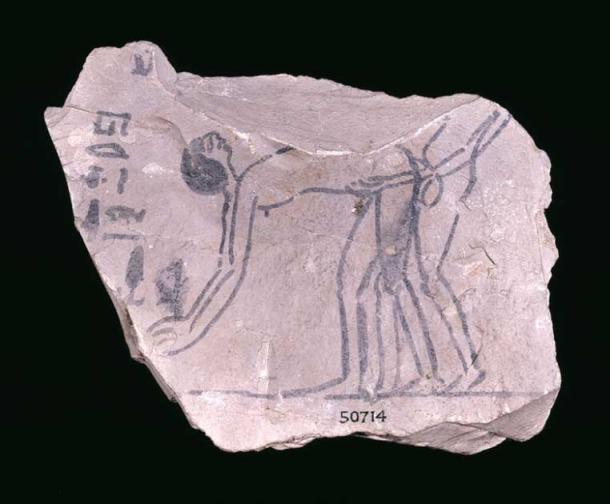
Une version plus tardive (20e dynastie, vers 1150 avant JC, donne plus de détails : Seth dit à Horus : « Allons passer une heure agréable chez moi. » Horus répondit : « Avec plaisir, avec plaisir. » Le soir venu, on leur fit un lit et ils se couchèrent. La nuit, Seth tendit son pénis et le plaça entre les cuisses d’Horus. Horus mit ses mains entre ses cuisses et attrapa la semence de Seth. Par la suite Seth allait avaler le sperme d'Horus.! On s'amusait bien chez les dieux égyptiens.. |
Khnumhotep and Niankhkhnum were not
the only ones to have engaged in homosexual relationships
in ancient Egypt. The myth of Horus and Seth refers not
only to homosexuality, but also to incest.
In the Pyramid Texts, discovered in 2001 in the pyramid of Pepi I, we see Seth and his nephew Horus engaging in sexual intercourse, which the Egyptian text makes no attempt to conceal, as in this excerpt: “If Horus deposited his seed in Seth’s buttocks, it is because Seth deposited his seed in Horus’s buttocks!” A later version (20th Dynasty, c. 1150 BC) provides further details: “Seth said to Horus: ‘Let us spend a pleasant hour at my place. ’ Horus replied: ‘With pleasure, with pleasure. ’ When evening came, a bed was made for them and they lay down. During the night, Seth stretched out his penis and placed it between Horus’s thighs. Horus put his hands between his thighs and caught Seth’s seed.’ Subsequently, Seth swallowed Horus’s semen ! Egyptian gods certainly knew how to have a good time... |
| Il peut sembler difficile de savoir ce que les Egyptiens pensaient de l'homosexualité. Les textes qui parlent d'actes sexuels ne donnent jamais aucun détail, ne précisent pas même la nature de l'acte mais, au contraire , utilisent des périphrases fleuries et des euphémimes. On peut tout de même comprendre que les Egyptiens ne réagissaient pas en termes d'hétérosexualité ou d'homosexualité mais en termes d'actif ou de passif. La société égyptienne acceptait qu'un homme ait des relations avec un autre homme, à condtion que l'homme soit le partenaire actif. (Dans le mythe d'Horus et Seth, Horus ne nie pas avoir eu une relation avec son oncle, mais il nie avoir été le récepteur de l'acte.) Etre passif était inconvenant, car une telle attitude était associée à celle de la femme. Et la femme était soumise à l'homme dans l'Egypte ancienne... Au contraire, le partenaire actif était reconnu et loué pour sa virilité. Bref, donner était bien mais pas recevoir. ! | It may seem
difficult to know how ancient Egyptians felt about
homosexuality. Documents relating sexual acts never give any details, not even the nature of the sexual deeds, but instead use flowery and euphemistic paraphrases. It seems clear, all the same, that Egyptian society largely accepted man to man intercourse, provided the man adopted an active role. (In the myth of Horus and Set, Horus did not deny having had intercourse with his uncle, but he denied having been on the receiving end of the act.) A passive role was not considered appropriate, because it was associated with women. And women were subordinate to men in ancient Egypt. On the contrary, the active partner was celebrated and praised for his virility. In short, it was OK to give but not to receive. |
| Accueil - Home |
| More SEX
& Culture - Cul & Cul-ture |